
Family & Cosmetic Dental PLLC
- Home
- Our Practice
- Services
- Patient Information
- Blog
- Contact Us
Last Updated: September 7, 2026
Dental anxiety is a genuine fear response that affects millions of Americans, and it often stems from past experiences rather than personal weakness (the NIH). The fear of dentists frequently develops after a single uncomfortable procedure, a feeling of helplessness in the chair, or even secondhand stories from family members. At Family & Cosmetic Dental PLLC, we see patients every week who have avoided checkups for years.
Avoidance behavior reinforces the fear cycle: the longer you stay away, the more your brain treats the dental office as a threat. This pattern can escalate from mild unease into dental phobia, where the mere thought of an appointment triggers a panic attack.
The good news is that fear of dentists is highly treatable. Psychological research consistently shows that gradual exposure, combined with practical coping strategies, can rewire your response to the clinical environment.
Before you can address your anxiety, you need to understand what specifically sets it off. Dental fear is rarely a single emotion; it's a collection of distinct triggers that vary from person to person.
Common triggers include the sound of the drill, the smell of the office, the feeling of being unable to see what's happening, fear of needles, or a past experience of feeling rushed or judged. Some patients also carry financial anxiety about treatment costs, which compounds the stress of the visit itself.
Write down every aspect of a dental visit that makes you uncomfortable and rate each on a scale of 1 to 10. You can't manage a fear you haven't named, and once you know your triggers, you can communicate them clearly and build a coping plan around each one.
Relaxation techniques are most effective when practiced before you arrive and deployed strategically during the procedure. The goal is to lower your baseline arousal so the dental work feels manageable.
Standard advice to "just breathe" rarely helps. What works is a specific pattern: inhale through your nose for a count of four, then exhale slowly through your mouth for a count of eight. The extended exhale stimulates the vagus nerve, activating the parasympathetic nervous system and lowering your heart rate (peer-reviewed research). Practice for five minutes twice a day in the week before your appointment so the pattern is automatic.
PMR gives your body a concrete task that competes with the anxiety response. The standard protocol, developed by physician Edmund Jacobson, involves tensing a muscle group for five seconds and releasing for ten seconds (apa.org). Start with your toes and work upward to the jaw, which is particularly important for dental patients, many people clench without realizing it. This interrupts the physical cycle of anxiety, which in turn reduces the mental spiral.
Distraction is not avoidance, it is a legitimate cognitive strategy that reduces the brain's capacity to process threatening stimuli. The most effective form is guided imagery that engages multiple senses: if you picture a beach, hear the waves, feel the sun, smell the salt air. This occupies more working memory, leaving less room for anxious thoughts.
For audio distraction, create a playlist of content that requires active listening, a podcast, an audiobook, or music with lyrics you know well. Avoid ambient or instrumental music, which allows your mind to wander. Download content in advance and confirm with your dental office that you can wear an earbud.
If you feel a panic attack building mid-procedure, use the 5-4-3-2-1 grounding method: name five things you can see, four you can touch, three you can hear, two you can smell, and one you can taste. In the dental chair, this might be the ceiling light, the chair fabric, the hum of equipment, the antiseptic smell, and the taste of toothpaste. This forces your brain to process present-moment sensory data, interrupting the catastrophic thinking that drives panic.
Relaxation starts the night before. Avoid caffeine on the day of your appointment, get adequate sleep, and consider a light meal before your visit, low blood sugar can worsen anxiety. If you use a weighted blanket at home, ask if you can bring it or if the office provides one.
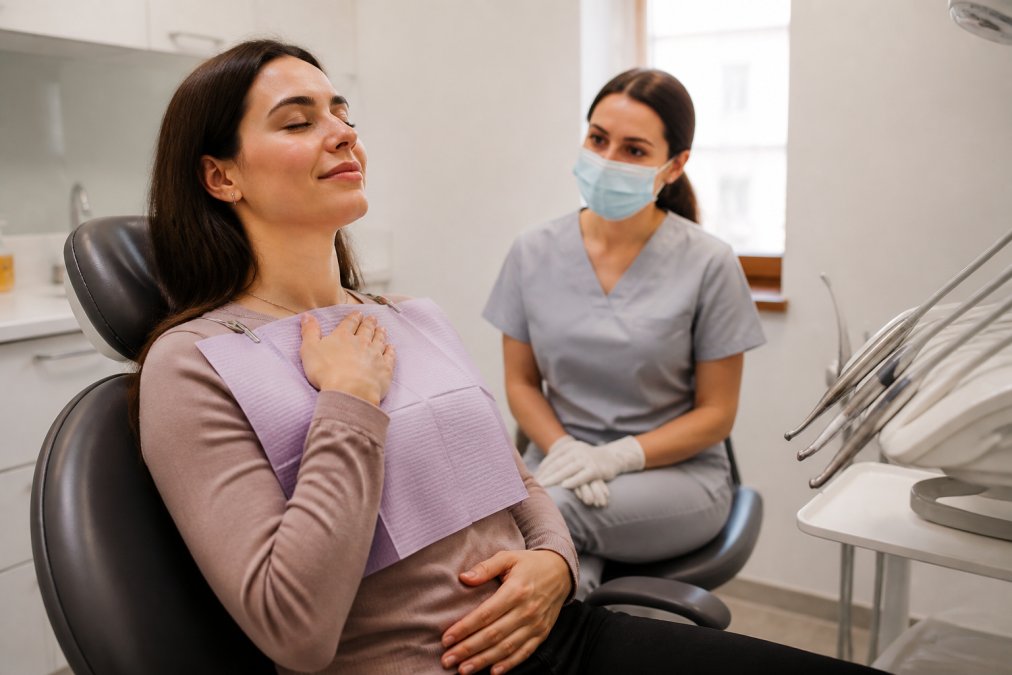
Have a layered approach: start with breathing, add PMR if tension builds, and keep a grounding technique ready for acute panic. Practice each at home so you know which works best.
Open communication is the single most important factor in a positive dental experience. A patient-centered dentist expects to hear about anxiety and has protocols in place to help. A simple statement like "I get very nervous at the dentist" is enough to change how your care is delivered.
Ask for a stop signal before any procedure begins. A raised hand or a specific word gives you control and directly reduces the fear response, changing the dynamic from helplessness to partnership.
During your consultation, discuss your specific triggers and ask the dentist to explain each step before they perform it. If you've had dental trauma, share what happened; a compassionate provider will adjust their approach rather than dismiss your concerns.
Sedation dentistry is a legitimate, widely used tool for managing moderate to severe dental anxiety. Options range from minimal sedation, where you remain awake but relaxed, to deeper levels where you have little memory of the procedure.
Nitrous oxide, often called laughing gas, is the lightest option and wears off quickly. Oral sedation involves taking an anti-anxiety medication before your appointment, leaving you drowsy but conscious. For more complex procedures or severe phobia, IV sedation provides deeper relaxation under medical supervision.
Your dentist will recommend an option based on the complexity of your treatment, your level of anxiety, and your medical history. Ask which options are available and what each one feels like.
The clinical environment itself can be a source of stress. The bright overhead light, the sharp sounds of instruments, and the sterile smell all contribute to the fear response, but you can take control with a few simple requests.
Ask if you can wear sunglasses to dim the overhead light, and request that the dentist explains each sound before you hear it. Some offices offer weighted blankets or allow you to bring a comfort item. These adjustments significantly reduce sensory overload.
The period after your appointment is the most overlooked phase in the dental anxiety cycle. What you do afterward determines whether your next visit becomes easier or harder.
Within 24 hours of your appointment, while the memory is still fresh, complete a structured reflection with three columns:
This exercise is about creating an accurate record. Anxiety distorts memory, making negative experiences feel worse and positive ones less significant. Before your next appointment, read this reflection as concrete evidence that you survived and that specific coping tools worked.
A common pattern after a difficult visit is relief followed by a gradual return of anxiety as the next appointment approaches. This is normal. The key is to interrupt the avoidance spiral before it starts.
Immediately after a successful visit, schedule your next appointment before you leave the office. This is a commitment device: the appointment is already on the calendar, and canceling requires an active decision. If you leave without scheduling, the default becomes avoidance.
Not every appointment will go perfectly. If you had a difficult experience, do not interpret it as proof that you cannot handle dental care. Instead, identify what went wrong and whether it was within your control or the provider's.
If the issue was physical, note what the dentist could have done differently and communicate that before your next visit. If it was emotional, that is information about the provider, not about you. A patient-centered dentist will want to know what went wrong; if they dismiss your feedback, find a different provider.
For patients with a long history of dental trauma, the goal is not to complete a major procedure on the first visit, it is to have a positive experience, however small. This might mean just sitting in the chair and talking, or getting a cleaning with the dentist narrating every step. Each small win builds self-efficacy, and over time these wins compound and the fear response diminishes.
If multiple appointments still trigger overwhelming anxiety despite these strategies, consider whether the issue is deeper than situational fear. Dental phobia often coexists with generalized anxiety disorder or PTSD, particularly if the fear stems from past trauma. Cognitive behavioral therapy (CBT) has a strong evidence base for phobias, and some therapists offer exposure therapy tailored to dental situations. Seeking professional support is a proactive step, not a failure.
Overcoming fear of dentists is a process, not a single event. It requires identifying your triggers, building a toolkit of relaxation techniques, and finding a provider who treats you as a partner in your care.
At Family & Cosmetic Dental PLLC, we understand that dental anxiety is real, and we've built our practice around making every patient feel safe and respected. Our team takes a conservative, compassionate approach to care, and we offer flexible payment options and accept a wide variety of PPO insurance plans to address financial concerns that often accompany dental fear. We invite you to schedule a consultation and experience how a supportive environment can change your relationship with dental care.
Yes, it is completely normal. Dental anxiety affects a significant portion of the population. You are not alone in feeling this way. Recognizing that your fear is a common response is the first step toward managing it. Many practices, including Family & Cosmetic Dental PLLC, are experienced in helping patients who feel nervous. They can offer specific strategies to make your visit more comfortable, so you can get the care you need without judgment.
Deep breathing, progressive muscle relaxation, and guided imagery are highly effective. Before your appointment, practice slow, deep breaths from your diaphragm. During the procedure, focus on tensing and relaxing different muscle groups to release physical stress. Many patients also find that listening to calming music or a podcast through headphones helps distract them from the clinical sounds. Try a few techniques at home to find what works best for you.
Be direct and honest from the start. You can say, 'I feel very anxious about dental visits, and I need your help to feel comfortable.' A good dentist will appreciate your honesty and adapt their approach. They can explain each step before they start, agree on a signal for you to pause, and adjust their pace. Asking questions about what you will feel is a practical way to reduce uncertainty and build trust with your care team.
Sedation options range from mild to moderate. Nitrous oxide, often called laughing gas, helps you relax while you remain awake. Oral sedation involves taking an anti-anxiety medication before your appointment. For more significant fear, IV sedation offers a deeper level of relaxation. Your dentist will discuss which option is appropriate for your level of anxiety and the procedure you need. A consultation is the best way to determine the right approach for you.
The fear of dentists doesn't have to control your oral health. Taking the first step, whether it's a phone call or a conversation about your anxiety, is the hardest part. Get started with Family & Cosmetic Dental PLLC and discover what a stress-free dental experience feels like.




