
Family & Cosmetic Dental PLLC
- Home
- Our Practice
- Services
- Patient Information
- Blog
- Contact Us
Last Updated: September 9, 2026
The cost of dental veneers in 2026 is not a single national number. It is a personalized figure driven by material, case complexity, and the provider's skill level. But the single most predictable driver of price variation across the United States is the cost of doing business in your specific market. A veneer placed in a high-cost urban center carries overhead that a rural practice simply does not have (the American Dental Association).
A common pattern in dental pricing is a direct correlation with the local cost of living index. Practices in metropolitan areas with high commercial real estate rates, higher staff wages, and higher lab fees must price veneers to cover those expenses. The same porcelain veneer that averages $1,200 per tooth in a mid-sized city can easily reach $2,500 per tooth in a high-cost urban corridor.
To make this concrete, consider the following cost-of-living impact on typical porcelain veneer pricing:
| Market Type | Cost-of-Living Index (Approx.) | Typical Porcelain Veneer Price Range (per tooth) | Primary Cost Driver |
|---|---|---|---|
| High-Cost Urban Center | 150+ | $1,800 - $2,500 | Commercial rent, lab fees, staff wages |
| Mid-Sized Metropolitan Area | 100 - 120 | $1,200 - $1,800 | Balanced overhead, moderate lab fees |
| Rural or Low-Cost Area | Below 100 | $800 - $1,200 | Lower rent, lower staff costs |
These ranges are not arbitrary (the American Dental Association). They reflect the economic reality that a dental practice's overhead, typically 60-70% of revenue, is tied to local real estate and labor markets. A practice in a high-cost area must generate higher per-procedure revenue to maintain the same profit margin as a rural practice.
Beyond geography, the dentist's clinical reputation and advanced training in cosmetic dentistry introduce a second layer of price variation. A dentist who has completed hundreds of veneer cases, maintains a portfolio of before-and-after results, and uses a master-level dental ceramist will command a premium. This premium is not arbitrary; it reflects a lower risk of aesthetic failure, better shade matching, and a more natural contour.
Finally, your individual case complexity acts as a multiplier on the base regional price. Simple cases, where teeth are already well-aligned and only minor shade or shape changes are needed, fall at the lower end of the range. Complex cases requiring significant enamel reduction, gum contouring, or orthodontic pre-treatment will push the price upward. A dentist must often perform additional diagnostic work, including digital smile design and wax-up models, to plan a complex case, and those services are reflected in the fee.
The bottom line is that the "why" behind price fluctuations is not a mystery. It is a combination of your local market's economic conditions, the clinician's demonstrated skill, and the specific clinical work your smile requires. Understanding these three variables is the first step toward an accurate budget, because veneers are a long-term investment in your smile, not a one-time purchase.
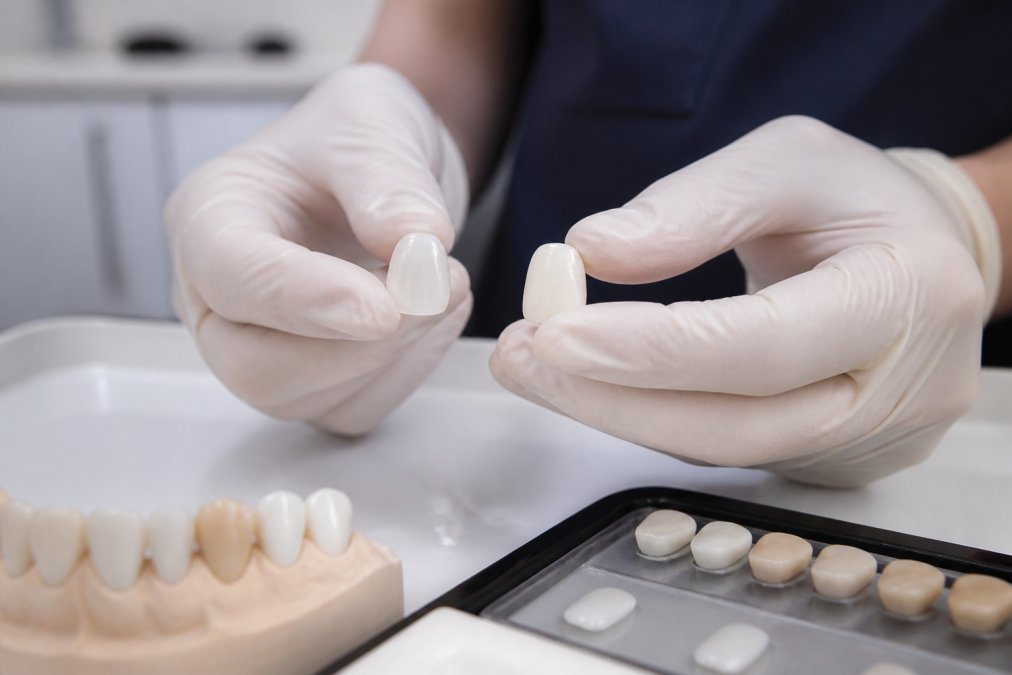
The material you choose is the primary cost factor, and the difference between porcelain and composite resin is substantial. Porcelain veneers are fabricated in a dental laboratory from ceramic materials, requiring at least two appointments, while composite veneers are applied directly by your dentist in a single visit using a bonding technique (mouthhealthy.org).
| Material | Typical Longevity | Procedure Time | Aesthetic Quality | Maintenance Needs |
|---|---|---|---|---|
| Porcelain Veneers | 10-15 years | 2-3 appointments | Superior stain resistance and light reflection | Minimal; may need replacement of bonding over time |
| Composite Veneers | 5-7 years | 1-2 appointments | Good, but can stain and chip more easily | More frequent polishing and potential repairs |
Porcelain veneers carry a higher upfront price per tooth because of the dental laboratory fees and the clinical expertise required for precise enamel reduction and placement. Composite resin is more budget-friendly initially, but it is important to factor in the higher maintenance costs over time. Composite veneers are more prone to staining from coffee and wine and may need periodic repair, which adds to the out-of-pocket expenses over the years.
Financing options are widely available because cosmetic dentistry is rarely covered by basic dental insurance. But before you sign any payment agreement, it is critical to understand the full financial picture: not just the monthly payment, but the total cost of borrowing and how that compares to the long-term value of the veneers themselves.
In-House Payment Plans. Many practices offer interest-free in-house payment plans for a defined term, typically 6 to 12 months. These plans are attractive because they avoid third-party credit checks and interest charges. However, they usually require a substantial down payment, often 20-50% of the total treatment cost, and the remaining balance is split into equal monthly installments. If you miss a payment, the practice may retroactively charge interest or send the account to collections.
Third-Party Patient Financing. Companies like CareCredit and LendingClub Patient Solutions are common in dental offices. These are healthcare-specific credit cards or installment loans. The key mechanism to understand is the promotional APR period. Many offer "0% APR for 12 or 18 months" if you pay the balance in full by the end of the promotional period. If you do not, the interest is often retroactively applied from the original purchase date at a rate that can exceed 25% APR. This is the single most expensive mistake patients make.
Personal Loans or Home Equity. Some patients choose to finance their veneers through a personal loan from a bank or credit union, or by tapping home equity. Personal loan APRs in 2026 for good credit typically range from 8% to 15%, depending on the term. Home equity loans or lines of credit may offer lower rates but put your home at risk if you default. These options are best for patients who want a fixed monthly payment outside the dental office's ecosystem.
Financing is only worthwhile if the investment makes sense relative to alternatives. A common pattern in cosmetic dentistry is that patients compare veneers to orthodontics or composite bonding without doing the long-term math. Here is a framework to evaluate the return on investment:
| Option | Upfront Cost (per tooth, typical range) | Expected Longevity | 10-Year Estimated Total Cost (per tooth, incl. maintenance) | Key Trade-Off |
|---|---|---|---|---|
| Porcelain Veneer | $1,200 - $2,500 | 10-15 years | $1,200 - $2,500 (if no issues) | Best aesthetics, most durable, highest upfront cost |
| Composite Veneer | $400 - $1,200 | 5-7 years | $1,200 - $3,000 (with repairs/replacement) | Lower upfront cost, but higher long-term maintenance |
| Orthodontic Alignment (for spacing/crowding) | $3,000 - $8,000 (full arch) | Permanent (with retainer) | $3,000 - $8,000 + retainer replacement | Addresses root cause, but does not change tooth color |
| Teeth Whitening + Bonding | $500 - $1,500 (per affected area) | 3-5 years for bonding | $1,500 - $4,500 | Least invasive, but limited aesthetic control |
This table illustrates the critical financial insight: a cheaper composite veneer that needs replacement in year five or six can easily exceed the total cost of a porcelain veneer over a decade. Conversely, if your primary issue is tooth alignment rather than color or shape, orthodontics may offer a better long-term ROI than veneers, which do not correct the underlying bite.
When evaluating dental veneer financing options, follow this sequence:
A practice that accepts a wide variety of PPO insurance plans and offers flexible financial options can help you structure a payment schedule that fits your budget. But the most financially sound decision is the one that aligns the financing term with the expected lifespan of the veneer. Financing a 15-year porcelain veneer over 24 months is reasonable. Financing a 5-year composite veneer over 60 months is a financial trap.
Dental insurance typically classifies veneers as a cosmetic procedure, which means coverage is limited or nonexistent. Most PPO plans will not contribute to the cost of veneers when they are placed solely for aesthetic reasons, such as improving the color or shape of otherwise healthy teeth.
There is a partial exception for restorative cases. If a veneer is used to restore a tooth damaged by trauma or decay, or to protect a tooth after a root canal, a portion of the procedure may be classified as restorative and eligible for some insurance reimbursement. This determination depends on your specific policy and the clinical documentation your dentist provides. The Family & Cosmetic Dental PLLC team recommends scheduling a dental consultation to review your benefit plan and understand your likely out-of-pocket expenses before committing to treatment.
The upfront price per tooth is only part of the financial picture. Veneers require maintenance, and budgeting for the long-term investment means accounting for potential repairs and replacements. Porcelain veneers are strong, but they can chip under extreme force, such as grinding or biting on hard objects. Repairing a chipped porcelain veneer often requires a full replacement because the ceramic material cannot be patched effectively.
Composite veneers present a different maintenance profile. While they are easier to repair in place, they require more frequent attention. You should also budget for routine dental health visits, as your dentist will monitor the margins of your veneers to ensure no decay is developing underneath. Good oral health and preventative care extend the life of your veneers, protecting the initial investment you made in your smile.
The only way to get an accurate cost estimate is to schedule a dental consultation with a qualified cosmetic dentist. During this visit, the dentist will examine your teeth, discuss your smile goals, and determine whether veneers are the right solution compared to alternatives like bonding or teeth whitening. You will receive a detailed treatment plan that outlines the number of veneers recommended and the associated fees.
When you meet with a provider, come prepared with a list of questions. Ask about the dentist's experience with veneers, the type of dental laboratory they use, and what the fee includes, such as temporary veneers and follow-up adjustments. A reputable practice will be transparent about the total investment and will never rush you into a decision. For patients in the Glendale and Peoria areas, a consultation at Family & Cosmetic Dental PLLC provides a clear path forward, combining clinical expertise with a focus on conservative, compassionate care.
The cost of dental veneers in 2026 is a significant investment, but it is one that can transform your confidence and your oral health. The key is to move past the sticker shock and focus on the value delivered by a skilled cosmetic dentist using high-quality materials. At Family & Cosmetic Dental PLLC, our team is committed to providing flexible financial options so you can achieve the smile you want without unnecessary stress. We invite you to book your experience today and take the first step toward a smile designed around your goals.
Porcelain veneers typically last 10 to 15 years with proper care. Composite veneers have a shorter lifespan of 5 to 7 years. Your habits, such as grinding or chewing on hard objects, and your oral hygiene routine directly affect how long your veneers last. Regular dental checkups help your dentist spot early signs of wear or damage before they become costly repairs.
Dental insurance rarely covers veneers because they are considered a cosmetic procedure. Some plans may contribute a small percentage if veneers are needed to restore a damaged tooth's structure or function. Review your policy's cosmetic exclusions and talk to your dental office about pre-treatment estimates. Many practices offer in-house savings plans or third-party financing to help manage the out-of-pocket expense.
Composite bonding is typically the most affordable alternative to porcelain veneers. It uses tooth-colored resin applied directly to your teeth and can often be completed in one visit. Costs depend on the amount of bonding needed and the complexity of the case. Teeth whitening or orthodontic treatment may also address your cosmetic concerns for less, depending on what your dentist finds during an exam.
Porcelain veneers cost more than composite veneers because they are custom-made in a dental laboratory from ceramic materials and require multiple appointments. Composite veneers are applied directly by your dentist and are less expensive per tooth. The total dental veneers cost depends on the number of teeth treated, your dentist's clinical expertise, and your location. Your treatment plan will outline the price difference based on your specific goals.




