What Is Conservative Dental Care and Why Does It Matter?
Conservative dental care is a treatment philosophy that preserves as much of your natural tooth structure as possible, intervening only when there is a clear clinical need. At Family & Cosmetic Dental PLLC, we explain it to patients as the difference between fixing a small problem now and rebuilding an entire tooth later. The approach prioritizes prevention, early detection, and minimally invasive techniques over aggressive removal of healthy enamel.
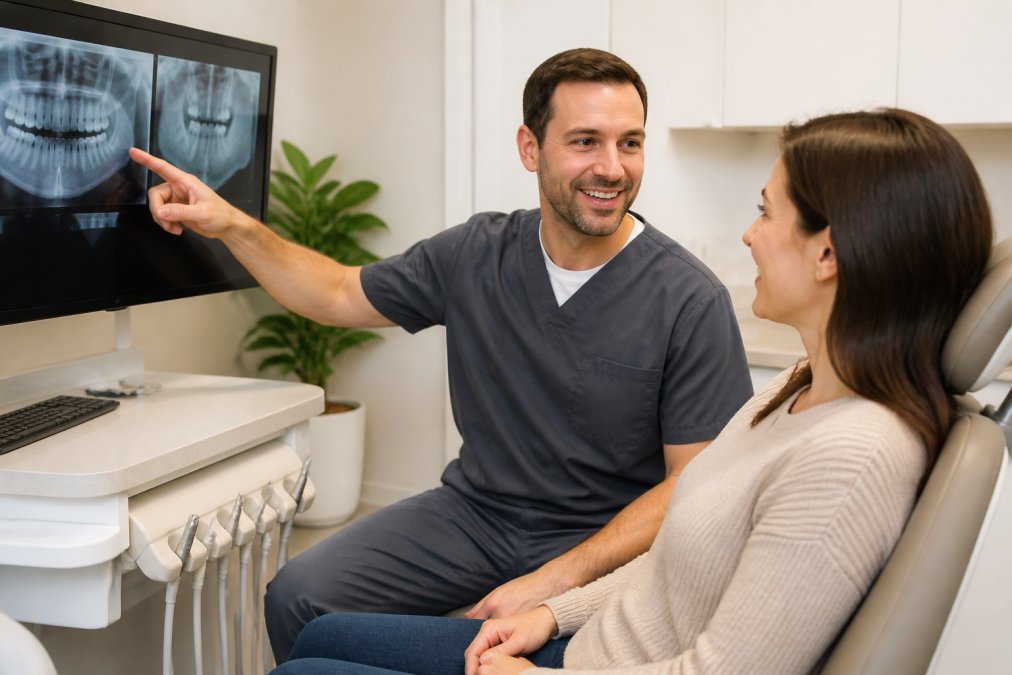
Dentist reviewing X-rays with a patient to explain the process of conservative dental care in a modern clinic
Core Principles of a Conservative Approach
Three principles guide every conservative treatment decision. First, do no unnecessary harm: healthy enamel is not removed to make a procedure easier. Second, repair rather than replace: a cracked filling gets repaired before the tooth gets a crown. Third, monitor rather than intervene: a small area of watchful waiting is often better than immediate drilling.
Conservative vs. Traditional Dentistry: Key Differences
The practical difference comes down to how much tooth structure is removed and how quickly treatment escalates. Traditional dentistry often moves from small filling to large filling to crown to root canal to extraction. Conservative dentistry tries to slow or stop that progression.
Factor
Conservative Approach
Traditional Approach
Small cavity
Bonding or small filling
Larger filling for access
Cracked filling
Repair or reseal
Full crown replacement
Minor enamel damage
Monitor and remineralize
Drill and fill
Treatment goal
Preserve natural teeth
Restore function quickly
Philosophy
Minimally invasive
Immediate intervention
Minimally Invasive Dentistry Techniques That Preserve Tooth Structure
Minimally invasive dentistry is not a single procedure, it is a set of tools and materials chosen specifically to remove less tooth. The technology matters because the amount of enamel a dentist removes is often a choice, not a clinical necessity. Here is what each tool actually does and why it preserves more structure.
Diagnostic technology that catches problems earlier
Intraoral cameras: A small wand-style camera projects a magnified image of a tooth onto a monitor. Patients see the same crack, stain, or cavity margin the dentist sees. This matters because early lesions that are visible but not yet cavitated can often be watched or remineralized instead of drilled.
Digital X-rays: Compared with film, digital sensors use a fraction of the radiation dose and produce images that can be enlarged, contrast-adjusted, and compared side-by-side over time. A dentist can track whether a suspicious area on a tooth has changed in 12 months or stayed stable, the basis for watchful waiting rather than immediate intervention.
Caries detection dyes and fluorescence devices: These highlight actively demineralized tooth structure so a dentist removes only the infected dentin and leaves the affected-but-remineralizable layer. Traditional excavation often removes both.
Treatment tools that remove less tooth
Air abrasion: A fine stream of aluminum oxide particles removes decay with minimal heat, vibration, and noise. It is often used for small, shallow cavities and can reduce or eliminate the need for local anesthetic in some cases. It does not work well for deep or large lesions.
Laser dentistry: Dental lasers can remove decayed tissue, reshape gum tissue, and treat some soft-tissue problems with less bleeding and often less removal of healthy surrounding structure than a drill or scalpel. Not every procedure is laser-appropriate, and lasers are an adjunct, not a replacement for a handpiece.
Bonding and adhesive dentistry: Composite resin bonds directly to enamel and dentin, so a small cavity can be restored without the mechanical retention a silver amalgam filling requires. That means less healthy tooth is cut away to hold the filling in place.
Inlays and onlays: These are laboratory-made or milled restorations that fit into or over a damaged area. An onlay preserves the cusps and much of the outer tooth wall that a full crown would remove. They are typically used when a filling is too large but a crown is not yet necessary.
Remineralization protocols: Fluoride varnish, prescription fluoride toothpaste, and calcium-phosphate products can reverse early enamel demineralization before a cavity forms. This is the least invasive option of all, no drilling, no restoration, but it only works on lesions that have not broken through the enamel surface.
What this looks like in practice
Pro Tip Ask your dentist to show you the X-ray or intraoral image before agreeing to any treatment. A conservative dentist will happily walk you through what they see and why they recommend a specific procedure over a more aggressive one. If they cannot or will not show you the image, that is useful information.
Why Do My Gums Bleed When I Brush My Teeth?
Bleeding gums when brushing usually signal gum inflammation, most often caused by plaque buildup along the gumline. This is an early sign of gingivitis, which is reversible with improved home care and a professional cleaning. It is not normal, and it should not be ignored.
Several factors contribute to bleeding gums:
Inconsistent brushing and flossing that lets plaque harden into tartar
Brushing too hard with a stiff-bristled toothbrush
Certain medications that affect gum tissue
Hormonal changes during pregnancy
Poorly fitting dental restorations that trap food
Dental Over-Treatment Signs: How to Spot Unnecessary Procedures
Over-treatment happens when a dentist recommends procedures that go beyond what the clinical situation requires. It is one of the most common reasons patients seek a second opinion, and it is a legitimate concern.
Watch for these signs:
Being pressured to decide on a treatment the same day without time to think
Recommendations for multiple crowns when fillings would suffice
No clear explanation of why a procedure is needed or what alternatives exist
Treatment plans that seem to escalate quickly from minor findings
Reluctance to show you X-rays or diagnostic images
Watch Out Agreeing to aggressive treatment without understanding why can lead to a cycle of repeated dental work. Each crown or extraction weakens the tooth further, and the next problem becomes harder to fix.
How Conservative Dental Care Supports Long-Term Oral Health
Conservative dental care protects the structural integrity of your teeth over decades, not just years. When you preserve natural enamel and avoid unnecessary removal, you keep more of the tooth that can withstand normal biting forces. This reduces the likelihood of fractures, sensitivity, and eventual tooth loss.
The cycle of failure works like this: a large filling weakens the tooth, the tooth cracks, a crown is placed, the crown fails, a root canal is needed, and eventually the tooth is extracted. Each step removes more structure and costs more money. Conservative care interrupts that cycle by treating problems while they are small and preserving the tooth's natural strength.
Insurance, Communication, and Making Care Affordable
Most articles about conservative dental care skip the part patients actually struggle with: the money and the conversation. Two misconceptions cause the most damage. The first is that conservative care is always cheaper. The second is that your dental insurance will reward you for choosing it. Neither is reliably true, and understanding why helps you make better decisions.
Why insurance sometimes favors the more invasive option
Dental benefits are structured around a fee schedule and a set of procedure codes. A small bonded filling, a large filling, an onlay, and a crown are four different codes with four different fees. In many plans, the plan pays a percentage of the allowed fee for whichever code the dentist submits, and the patient's out-of-pocket cost can be lower for a crown than for a series of smaller, staged conservative treatments spread across multiple visits and multiple deductible periods.
A few patterns are worth knowing:
Annual maximums reset every year. If a conservative plan requires treatment across two calendar years, you may pay two deductibles and hit two annual maximums. A single crown done in one year may cost you less out of pocket even though it removes more tooth.
Frequency limitations. Some plans limit how often certain procedures, cleanings, exams, fillings on the same tooth, can be billed. A conservative staged approach can bump into those limits.
Downgrades and alternative benefit clauses. Many plans will only pay for the least expensive procedure that meets the clinical need, regardless of what your dentist recommends. If your dentist recommends an onlay but the plan's least expensive equivalent is a filling, the plan may pay at the filling rate and you cover the difference.
Pre-authorization. For larger treatment plans, ask the office to submit a pre-treatment estimate. It is not a guarantee of payment, but it tells you what the plan expects to cover before you commit.
Questions to ask before you agree to treatment
Bring this list to your next appointment. A practice that welcomes these questions is a practice that respects your role in the decision.
What is the clinical reason for this procedure, and what happens if we wait three to six months and re-check?
What is the least invasive option that would address this, and what are its trade-offs?
Is there a more conservative code that could be billed, and how would that change my out-of-pocket cost?
Can you submit a pre-treatment estimate to my plan before we schedule?
Can I see the X-ray or intraoral image and have a copy of the treatment plan in writing?
If I choose the conservative option and it fails, what is the next step and what would it cost?
Communication and anxiety
Watch Out Do not assume that a more expensive treatment plan is automatically the more thorough one, or that a cheaper one is automatically conservative. Ask what is being removed, why, and what the alternatives are. The right question is not 'which costs less today' but 'which preserves the most tooth while solving the problem.'
Frequently Asked Questions
Is a conservative dentist better for long-term oral health?
A conservative dentist focuses on preserving as much natural tooth structure as possible, which often leads to better long-term outcomes. By using minimally invasive techniques and only treating what is necessary, conservative dental care reduces the risk of weakening teeth through repeated drilling or unnecessary crowns. This approach also lowers the chance of needing more complex procedures down the road. For patients who want to maintain their natural smile and avoid the cycle of failure, a conservative dentist can be a smart choice.
What are the dental over-treatment signs I should watch for?
Common dental over-treatment signs include being pressured to accept multiple crowns or fillings when you have no pain or visible damage, a lack of explanation about why a procedure is needed, and no discussion of preventative options. If your dentist does not show you X-rays or intraoral images to justify treatment, or if you feel rushed into a decision, seek a second opinion. A conservative dentist will always explain the why behind each recommendation and offer less invasive alternatives first.
Can conservative dental care save patients money?
Yes, conservative dental care often saves money over time by preventing small issues from becoming major problems. Early detection and preventative care, such as sealants or fluoride treatments, cost far less than root canals or implants. Additionally, minimally invasive techniques like fillings and bonding preserve more of your natural tooth, reducing the need for expensive crowns later. Many dental insurance plans cover preventative services at 100%, making conservative care both clinically and financially smart.
How does conservative dentistry differ from aggressive treatment plans?
Conservative dentistry prioritizes preserving natural tooth structure and only intervening when necessary, while aggressive treatment plans may recommend extensive procedures like full crowns or extractions at the first sign of trouble. A conservative dentist will often use minimally invasive techniques such as inlays, onlays, or dental bonding, and will monitor small issues with preventative care. This patient-centered approach aims to extend the life of your natural teeth and avoid the cycle of repeated dental work.
With over 30 years of experience, Dr. Adrian Pulkrabek and his team combine science and artistry to prioritize your comfort and oral health. From routine cleanings to complete smile redesigns, we offer state-of-the-art restorative and cosmetic dentistry in a friendly, welcoming environment.
Trustindex verifies that the original source of the review is Google.
Great Dentist!! Office staff, simply put, are just darn good people. Kathleen always greets you with a smile and a friendly welcome. Sarah is the Dental Assistant and Hygienist; she's wonderful, always making sure I feel comfortable and it shows by how she treats a patient (me). All 3 are very professional!! The office is very clean, and the front desk area is organized and well maintained by Kathleen. That being said, Dr. Pulkrabek is an excellent Dentist. Explains every procedure very well, detailed and also making sure I understand and he makes sure I feel comfortable during my visit. One of the great benefits when I'm in the Dental chair and Dr. Pulkrabek is working his magic on my teeth, It's always been practically painless Dentistry. I'm always extremely pleased with the outcome of the Dr's work on my Ivorys!! My overall experience has been outstanding with each visit. I highly recommend making an appointment with Dr. Pulkrabek for your Dental needs and concerns.
Posted on Google
Renee C
Trustindex verifies that the original source of the review is Google.
I have been a patient of Dr. Pulkrabek and his team since probably 2005/2006. I have pretty severe dental anxiety and he is the only reason I’m able to show up for my six month cleanings. He is so gentle, thorough, knowledgeable, and fun. He is efficient. Contemplating a move out of the State and joked that we would probably keep him as our provider and just come back for cleanings. He is that good. Such an amazing dentist.
Posted on Google
Barbara L
Trustindex verifies that the original source of the review is Google.
I have always been pleased with the staff and the doctor. The office manager is professional, and her experience shows as she engages with clients. The doctors assistant is professional, and very pleasant to deal with. The doctor himself, is knowledgeable, professional and always treats me as if I’m his only patient and I have no complaints about my dental care from him.
Posted on Google
Jordynn B
Trustindex verifies that the original source of the review is Google.
Amazing Dentist! Staff was very friendly and I got an appointment very quickly! They gave me a great referral and helped with all my questions and concerns!
Posted on Google
Megan T
Trustindex verifies that the original source of the review is Google.
Amazing dentist! Everyone in the office is amazing and professional. They made me feel at ease and this was the first time going to the dentist. They explain each procedure and how it will benefit your teeth and health.
Posted on Google
Candice H
Trustindex verifies that the original source of the review is Google.
Dr. Pulkrabek and his staff are great. We have been coming here for years and would highly recommend.
Posted on Google
Ahmed M
Trustindex verifies that the original source of the review is Google.
Dr. Adrian was super helpful and explain everything to me! Super easy visit. Extremely friendly staff that helped me with all the insurance and billing!
Posted on Google
Julian M
Trustindex verifies that the original source of the review is Google.
Dr. Pulkrabek is a great dentist, and he does a very good job cleaning and examining teeth. He found a cavity growing underneath a prior filling after taking a closer look. The office staff and dental hygienists are all friendly and professional. I am looking forward to my next visit.
Posted on Google
Natasha L
Trustindex verifies that the original source of the review is Google.
Great office! Everyone is super helpful and does a great job