
Family & Cosmetic Dental PLLC
- Home
- Our Practice
- Services
- Patient Information
- Blog
- Contact Us
Last Updated: November 5, 2026
Quick Summary
To read a dental insurance EOB, compare the submitted charge, allowed amount, plan payment, and patient responsibility line by line, then check the procedure codes and date of service against your visit. A dental insurance EOB is not a bill, so pay from the dentist's bill only after the patient responsibility matches.
A dental insurance EOB (Explanation of Benefits) is a statement from your dental plan that shows what was billed, what the plan paid, and what you may owe.
Many patients ask whether they need to pay an EOB. In general, the answer is no.
Here is what most people get wrong. They treat the EOB as junk mail or as a surprise invoice. Both reactions cost them money.
Below, this guide walks through the fields on the statement, explains the dollar amounts, and describes what to do when something looks off.
(/blog/managing-dental-costs-without-insurance-guide/) covers options when coverage runs short.
Three quick ways to tell them apart:
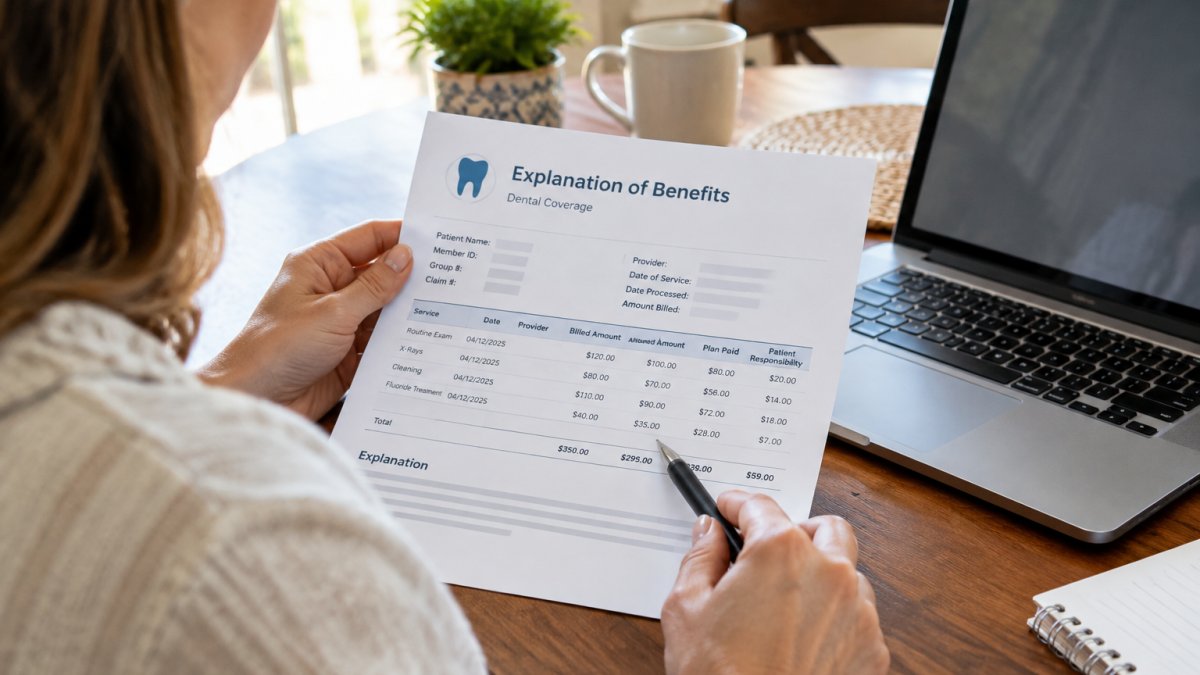
Keep every EOB. Do not pay from one. Pay from the bill.
Most dental plans now post EOBs in a member portal, and learning to read your dental insurance explanation of benefits online is faster than waiting for paper.
Follow these steps:
Watch out: portals often archive older claims. Download and save each EOB as you receive it, or you may lose access when the plan rolls to a new year.
For privacy, avoid opening EOBs on shared or public computers. These statements contain your member ID and health details.
Four numbers tell the whole story, and they rarely match. Here is what each one means and how they connect.
The submitted charge is what the dentist billed. The allowed amount is the negotiated fee your plan accepts. The plan payment is what insurance actually paid.
For in-network care, you are generally not responsible for the difference between the submitted charge and the allowed amount, because that gap is typically a write-off under your plan contract.
| Field | What It Means | Who It Applies To |
|---|---|---|
| Submitted charge | Dentist's billed amount | Starting point for the claim |
| Allowed amount | Negotiated fee | In-network and out-of-network rates |
| Plan payment | What insurance paid | Reduces your balance |
| Patient responsibility | Your share | Deductible, coinsurance, copay |
The relationship is simpler than the statement makes it look. For an in-network claim, the allowed amount splits into two pieces: what the plan paid and what you owe.
Allowed amount − Plan payment = Patient responsibility
The submitted charge sits outside that equation. It only matters for out-of-network care, where the difference between submitted and allowed can become balance billing.
Work through a single filling to see it:
The $85.00 gap between submitted and allowed never reaches you in-network.
If you or your dependents are covered by two dental plans, say, through your employer and a spouse's, the EOB will show a coordination of benefits (COB) line, and the numbers will not follow the simple equation above. One plan is primary and pays first; the other is secondary and considers the remaining balance.
A common pattern looks like this:
That outcome is not guaranteed. The secondary plan may pay less or apply its own deductible.
If you have two plans but only one was billed, the secondary plan may still owe something, so check with your plan before paying the balance out of pocket.
If a major procedure is on your EOB, our article on whether PPO insurance covers dental implants explains how those larger claims are typically handled.
A dental insurance claim denial means the plan did not pay a service, and the EOB will state a reason.
Denials can occur for many reasons, such as coverage limits or coding issues. The EOB's remark code or denial reason will state the specific cause.
Here is the workflow we recommend:
If you need to find a provider who works with your plan, our guide on how to find PPO dental providers walks through the search.
Before you pay anything, put the EOB and the bill side by side. The patient responsibility on the EOB should match the balance on the bill. If it does not, ask why before money changes hands.
Check these items:
If the balance is confirmed and you need help paying it, we offer Cherry financing for dental care at our Glendale office so you can split the cost over time.
Reading an EOB gets easier with practice, and it pays off. You catch errors, track remaining benefits, and stop paying bills you do not owe.
Bring your latest EOB to your next appointment. Our team will sit down with you and walk through it line by line.
Get started with Family & Cosmetic Dental PLLC and take the confusion out of your dental benefits.
No. A dental EOB is an information statement from your insurance plan showing how a claim was processed. It lists the services, the dentist's submitted charges, the allowed amount, what the plan paid, and your patient responsibility. A bill comes from the dental office and states what you actually owe. If the EOB shows a patient responsibility, wait for the dentist's billing statement before sending payment, and call the office if the two documents do not match.
First, find the remark code or denial reason printed on the statement. Common reasons include missing frequency limits, noncovered services, or missing information from the dental office. Call your dentist's billing team and ask them to review the claim; many denials are fixed by resubmitting with corrected codes or additional documentation. If the denial stands, you can file an appeal with your plan. Keep a copy of the EOB and note the date you called.
Log in to your dental plan's member portal and open the claims section. Select the claim by date of service and claim number. The online version shows the same fields as a paper EOB: procedure code, service description, submitted charge, allowed amount, plan payment, and patient responsibility. Download the PDF for your records and compare the patient responsibility line to the bill from your dental office. If the portal shows a claim status of processed, the EOB is final.
The allowed amount is the negotiated fee your plan has agreed to pay in-network dentists. Your dentist may submit a higher charge, but the plan only recognizes the allowed amount. For in-network care, you typically owe only your coinsurance or copay based on that allowed amount, not the difference. If you see a large gap between the submitted charge and the allowed amount, check whether the dentist was in-network for that date of service.


