
Family & Cosmetic Dental PLLC
- Home
- Our Practice
- Services
- Patient Information
- Blog
- Contact Us
Last Updated: September 13, 2026
Dental anxiety is a persistent feeling of fear or unease about visiting the dentist, and it affects a substantial share of adults. According to the Cleveland Clinic overview of dental anxiety, fear of the dentist ranks among the most commonly reported health-related fears, and many people delay care for years because of it.
That avoidance is not a character flaw. It is a learned response, and learned responses can be unlearned.
The fear usually traces back to a few sources: a painful childhood procedure, feeling rushed or judged, sensory overload from clinical sounds and smells, or fear of the unknown. The most common mistake is assuming the fear is permanent. In practice, anxiety responds well to preparation, communication, and gradual exposure, exactly what the steps below are built around.
Say the words out loud at the start of the visit: "I have dental anxiety, and I need you to go slowly." That single sentence changes the entire appointment. A good practice will build a treatment plan around it.
Communication works best when it is specific. Instead of "I hate the dentist," try "the drill sound is what gets me" or "tell me before you touch anything." Naming the trigger gives your dentist something to work with. Agree on a raised hand that means "pause now," and confirm it will be respected without question. If a practice brushes that off, that is your answer about whether it is the right fit.
Relaxation techniques for dental appointments are physical skills, not personality traits, and they work best when practiced before you need them. Try one at home first, in a calm setting, so it is familiar by the time you are in the dental chair.
Start with slow breathing: in through the nose for four, hold for four, out through the mouth for six. Longer exhales signal safety to your nervous system. Pair it with guided imagery, picturing a calm place in detail, down to the temperature and sounds.
Other evidence-backed approaches include progressive muscle relaxation, tensing and releasing each muscle group from toes to jaw, and mindfulness, noticing the sensation without judging it. Biofeedback, where you watch your breathing or heart rate on a monitor and learn to slow it, helps some patients too. The goal is not zero anxiety, but keeping it low enough that you stay in the chair.
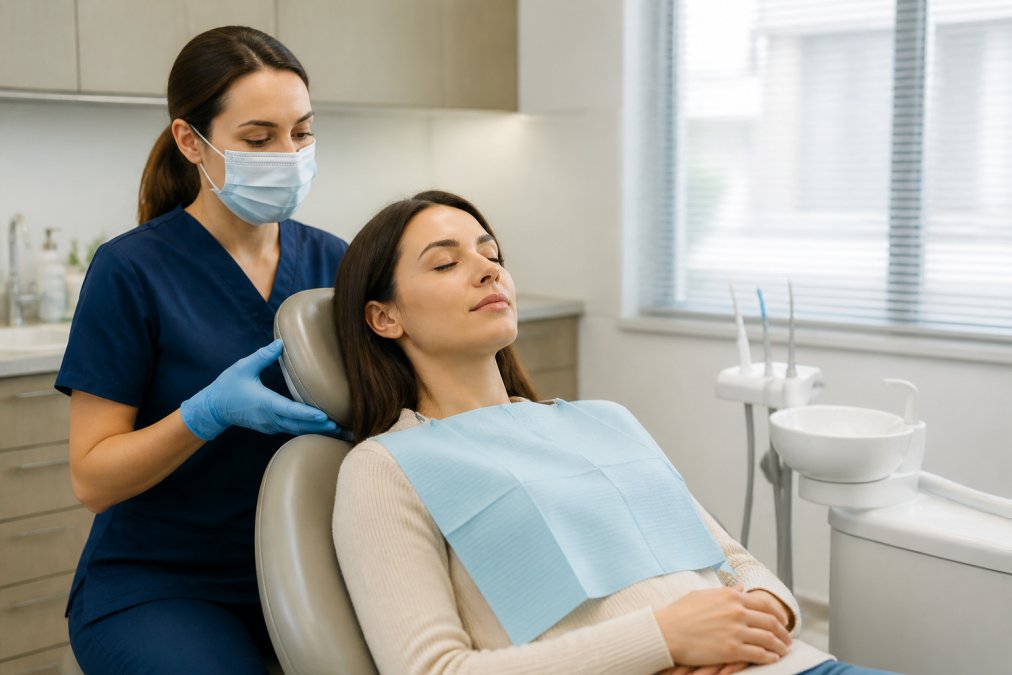
Dental sedation options range from mild to deep, and matching the level to your fear is the whole game. The American Dental Association's guidance on sedation and anesthesia outlines the categories and the training required to administer each. What most guides skip is how each level actually feels, how quickly it starts and fades, and what it changes about your day afterward.
Local anesthesia numbs a specific area and is used for nearly every filling or extraction. This is where needle fear gets addressed: topical numbing gel is applied to the gum first, so the injection is often felt as pressure rather than a pinch. Many practices use computer-controlled delivery systems that meter the anesthetic slowly instead of one push, which patients most often describe as the sharp sensation.
Nitrous oxide, or laughing gas, is inhaled through a small mask over the nose. It takes effect within minutes, produces a floating or slightly detached feeling, and is titrated, the dentist can dial the level up or down during the visit. It wears off within minutes of removing the mask, so most people drive themselves home. It does not put you to sleep; you stay responsive and can still raise a hand to pause.
Oral sedation uses anti-anxiety medication such as diazepam or triazolam, taken about an hour before the appointment (the American Dental Association). It produces drowsiness and often a hazy memory of the visit, which is a large part of why it works for patients with severe fear. The trade-off is timing: effects last several hours, so you need a driver and should not work or drive for the rest of the day. Your dentist will confirm the dose and timing in advance and may ask someone to stay with you afterward.
IV sedation delivers medication directly into the bloodstream and can be adjusted in real time by a qualified provider, producing a deeper, more reliable level of sedation for lengthy or complex treatment. Because the provider must be trained and equipped to monitor you throughout, it is offered less widely than the others and requires the most preparation on your end.
| Option | How It Works | Onset / Duration | Best For | Recovery |
|---|---|---|---|---|
| Local anesthesia | Numbs the treatment area, often after topical gel and slow delivery | Immediate / 1-3 hours of numbness | Routine fillings, most procedures | Immediate, but avoid chewing until numbness fades |
| Nitrous oxide | Inhaled through a nose mask, adjustable during the visit | Minutes / wears off in minutes | Mild to moderate anxiety | Minutes; most people drive themselves |
| Oral sedation | Pill taken about an hour before the visit | ~1 hour / several hours | Moderate to severe anxiety | Rest of the day; driver required |
| IV sedation | Delivered and adjusted by a qualified provider | Rapid / visit-length | Complex or lengthy treatment | Rest of the day; driver required |
Two fears drive most avoidance: the needle and the drill. Both have changed more in the last decade than most patients realize.
Preparation lowers fear of the unknown more than reassurance does. Fear of the unknown is driven by the brain filling gaps with worst-case scenarios, and every concrete detail you supply in advance replaces one of those scenarios with something predictable. The goal of preparation is not to feel calm; it is to make the visit boring.
Ask the front desk what will happen, in order: check-in, paperwork, being seated, the exam, the cleaning or treatment, checkout. Write the sequence down, then ask how long each part takes and what happens if you need to stop. Knowing the exit ramp exists is often what makes the rest tolerable.
If you can, drive past the office once beforehand, or look at photos of the treatment room online. Familiarity with the physical space reduces the startle response when you walk in, the same principle behind graded exposure: small, low-stakes contact with the feared thing, repeated, until the nervous system stops treating it as a threat.
If your fear is severe, do not book a full treatment as your first visit. Build a ladder:
Each rung is a win and makes the next one smaller. Anxiety fades with repeated positive experiences, not with one brave appointment.
Book the earliest appointment of the day if you can: waiting time is shortest in the morning, and you have less of the day to dread it. Eat a light meal unless told to fast for sedation, and skip caffeine, it amplifies a racing heart and makes anxiety symptoms harder to distinguish from real ones.
Bring a written list:
Bring headphones and a charged phone loaded with something familiar, a known podcast or album is more distracting than new content. Wear comfortable clothing with short or loose sleeves so a blood pressure cuff fits easily. If a friend or family member can drive you, that opens up sedation options you would otherwise skip, and a familiar face in the waiting room calms many patients.
Distraction techniques work because anxiety needs attention to grow. Noise-cancelling headphones playing a podcast or album you know well block the drill sound, one of the most common triggers. Sunglasses cut the glare of the overhead light, and a weighted blanket or folded jacket across your lap gives your hands something to do.
Agree on a physical signal before treatment starts, such as a raised left hand, and use it early rather than enduring in silence. A short first visit, a cleaning or a single filling, rebuilds trust faster than booking everything at once. Ask about breaks in advance; knowing you can stop at any point often means you never need to.
The appointment is not over when you leave the chair. Give yourself the rest of the day to come down from the adrenaline, especially after oral sedation. Skip heavy meals and alcohol until numbness wears off, and avoid hot drinks while your mouth is still numb, since you cannot feel a burn.
Then reinforce the win. Note what helped, which technique, signal, or music, and tell your dentist at the next visit so the same setup can be repeated. Anxiety fades with repeated positive experiences, not a single good appointment. Booking your next cleaning before you leave the front desk removes the months of dread that avoidance feeds on.
A child's dental anxiety is usually learned, often at home. Never use the dentist as a threat, and avoid words like "shot," "drill," or "hurt" in front of a child. Describe the visit in plain, positive terms: the dentist counts your teeth and takes a picture of them.
Schedule a first visit early, ideally by age one, so the office becomes familiar rather than frightening. Let the child bring a comfort object and sit on your lap if the practice allows. Model calm yourself, because children read parental tension accurately. If your child has had a dental trauma, tell the dentist beforehand so the team can adjust the pace rather than pushing through.
Dental anxiety is common, treatable, and not something you have to white-knuckle your way through alone. Family & Cosmetic Dental PLLC was built for exactly this: conservative and compassionate care, a team that accepts a wide variety of PPO insurance plans, flexible payment options including third-party financing, and an in-house savings plan for patients without coverage. Our patients regularly tell us that a calm, unhurried environment is what finally got them back in the chair. Book your experience today with Family & Cosmetic Dental PLLC and take the first step toward dental health without the fear.
Dental anxiety often stems from a combination of factors: fear of pain, previous negative experiences, feeling out of control, or embarrassment about oral health. The clinical environment itself, with its sounds and smells, can trigger a stress response. Research shows that dental phobia affects a significant portion of adults, and it is a recognized psychological condition, not a personal failing. Understanding your specific triggers is the first step toward managing them.
Start by communicating your fear to your dentist before your appointment. Many practices offer dental sedation options like nitrous oxide or oral sedation to help you relax. You can also try relaxation techniques for dental appointments such as deep breathing, guided imagery, or progressive muscle relaxation. Bringing a trusted friend or listening to music can help. The key is finding a dentist who listens and works at your pace.
Common triggers include the sound of the drill, the smell of the clinic, the sight of needles, feeling vulnerable in the dental chair, and fear of the unknown. Sensory overload from bright lights and unfamiliar instruments can also contribute. Some people have a history of dental trauma or painful procedures. Identifying your specific triggers helps you and your dentist plan coping strategies, such as noise-canceling headphones or requesting a stop signal during treatment.
Overcoming dental anxiety typically involves a combination of communication, relaxation, and gradual exposure. Start by scheduling a consultation-only visit to meet the dentist and tour the office without treatment. Use relaxation techniques like deep breathing or mindfulness before and during appointments. Ask about dental sedation options if needed. Many patients find that regular, positive experiences with a compassionate dentist gradually reduce their fear over time.


