
Family & Cosmetic Dental PLLC
- Home
- Our Practice
- Services
- Patient Information
- Blog
- Contact Us
Last Updated: October 27, 2026
Quick Summary
To manage dental anxiety during exams, tell your dentist plainly and early that you get anxious, and agree on a pause signal such as a raised hand before the visit starts. You can also use slow breathing like box breathing or a long exhale in the chair, and book a morning slot so you are not waiting all day.
Dental anxiety is a real, physical response to the sights, sounds, and smells of a dental office, not a character flaw. It often starts with a bad memory or a fear of pain, and it can keep people away from care for years. Dental anxiety is not a character flaw.
Skipped exams can mean missing opportunities to discuss preventive or restorative care. Research on the origins of dental anxiety shows that early negative experiences often plant the fear that lingers for decades. That is why learning how to manage dental anxiety during exams matters so much.
If you recognize yourself here, our step-by-step guide to overcoming dental anxiety walks you through it in more detail.
Say it plainly and say it early. A short sentence like "I get very anxious at the dentist" gives your care team the information they need to change how they treat you. You do not need to explain or apologize.
Here is what to share before your appointment, ideally when you book:
You may choose to tell your dentist what concerns you. A 2026 review in Public Health Reviews found that clear communication between patient and provider is a core part of managing dental fear, not an optional extra.
A routine exam may include a look, a feel, and a conversation. For the full breakdown of what a dental exam checks and how findings guide preventive or restorative care, see our detailed page. You can ask your dentist about the sequence and whether you can pause. New patients can read a detailed walkthrough of a first exam so the unknown feels less scary.
Our focus includes preventive and restorative care.
Slow, steady breathing is one technique you can try in the chair. It gives your mind something to focus on.
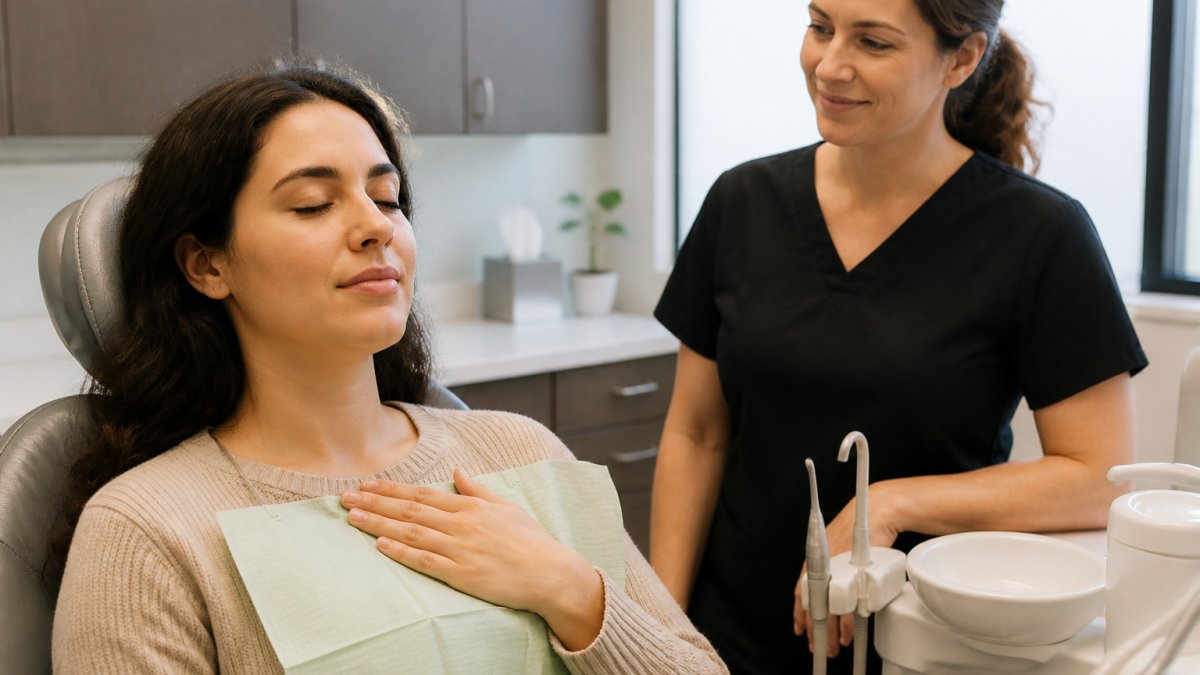
Try these:
Research in Dimensions of Dental Hygiene notes that non-drug strategies like breathing and music can lower blood pressure and heart rate during treatment.
These are the in-chair techniques the article suggests trying, each with its own pattern or purpose.
| Technique | How to do it |
|---|---|
| Box breathing | Inhale four counts, hold four, exhale four, hold four |
| Long exhale | In through nose for four, out through mouth for six |
| Hand on chest | Rest one hand on chest and feel it rise and fall |
| Pause signal | Agree on a raised hand before the visit starts |
You can try coping strategies before and during a visit.
Before the visit:
During the visit:
Watch out: canceling at the last minute feels like relief, but it teaches your brain that the dentist is worth avoiding. Rescheduling is better than canceling. For a wider set of techniques, see our guide on how to overcome fear of dentists.
Pick a dentist who treats anxiety as part of the job, not an inconvenience. The right practice will ask about your fear before you arrive and adjust the visit around it.
Look for these signs:
Renee C. says, “I have been a patient of Dr. Pulkrabek and his team since probably 2005/2006. I have pretty severe dental anxiety and he is the only reason I’m able to show up for my six month cleanings.” Our guide to finding a compassionate dentist covers what to ask on the phone before you commit.
You can tell the office you are anxious when you book.
Family & Cosmetic Dental PLLC takes a conservative, compassionate approach. We accept a wide variety of PPO insurance plans and offer flexible payment options, including third-party financing and an in-house savings plan, so cost does not add to the stress.
Get started with Family & Cosmetic Dental PLLC.
Start the day before. Ask the office what the visit will involve so there are no surprises, and tell them you have dental anxiety when you book. On the day, you can try slow breathing with a longer exhale than inhale and bring headphones and a playlist. You can also call ahead to ask what the visit will involve.
You can try a 4-6 breath: inhale through your nose for a count of four, then exhale slowly through your mouth for a count of six. You can repeat the exercise if you wish.
You can ask your dentist whether you can agree on a stop signal before the exam begins. A raised hand is one option to discuss. You can also tell the dentist what you need and ask how they handle pauses.
Be direct: say you have dental anxiety, describe what specifically worries you (pain, the sound of instruments, feeling rushed, past bad experiences), and name what helps, such as music, frequent breaks, or a signal to pause. Ask what to expect during a dental exam so you know the sequence. You do not need to minimize it. You can ask what to expect during a dental exam so you know the sequence.


